What a good builder shows you
A good deck builder can explain, without dodging, how the ledger board gets installed and flashed against the house wall, how joists are spaced and spanned, and what fastens the decking. Ask to see the hardware list, not just a rendering. If the hangers, connectors and fastener type are named in the bid, the builder has already thought the job through. If they're missing, expect those decisions to be made on site.
Ask how the framing is detailed for local ground and weather. Grants Pass has mixed soils that hold a moderate amount of moisture, and occasional winter freezes move the ground a little. That's not dramatic, but a builder should be able to say how it affects the way the deck is framed and tied together. A blank look is a bad sign.
Also ask how changes get handled once work starts. A post line shifts, a member needs a different connector, a fastener schedule changes with the material. You want a builder who tells you plainly and updates the paperwork to match. A bid that is vague about materials, hardware or the house connection is usually vague for a reason.
The permit question, answered plainly
We don't guess at whether your deck needs a permit. It depends on the project, such as how high it sits, whether it attaches to the house, and whether it has stairs, rails or a cover. We confirm what applies to your deck with the reviewing authority before framing materials are ordered or the ledger is set.
Review can change the sequence of work, so a builder who treats it as paperwork may be ready to swing hammers before approval is settled. We'd rather start a little later than have you find a problem afterward. When you compare bids, ask each contractor how they handle plan checks and timing, and what happens if field conditions differ from the drawing. The right answer isn't a promise that nothing will change. It's a clear method for handling changes.

What happens when the crew arrives
The first work isn't the pretty part. We install and flash the ledger board where the deck meets the house, because that's where water and movement cause trouble if it's done carelessly. Joists then go in at code-compliant spacing and spans, fastened with the appropriate hangers or connectors.
Decking comes last. Each board is fastened to every joist with two ring-shank 8D nails or 2-1/2 inch wood screws, or the specified deck screws. Ring-shank nails resist backing out as the boards swell and shrink. With freeze-thaw movement and soil that holds moisture, we want that fastening to stay tight.
Where the cost shows up
Framing materials (joists, beams, posts and hardware) run about $1,800 to $3,000. Deck screws or hidden fasteners run from $56 to $1,100, and the spread depends on which fastening system the decking calls for. Hidden fasteners sit at the top of that range.
When you compare bids, look at where those line items sit. A low number that says nothing about hangers, connectors, flashing or fastener type may just be pushing cost into change orders later. A higher number should tell you what the extra money buys, whether that's a better attachment at the house, more consistent joist framing, or a fastening schedule suited to the decking. If you want numbers for your own lot, a free quote is the next step.
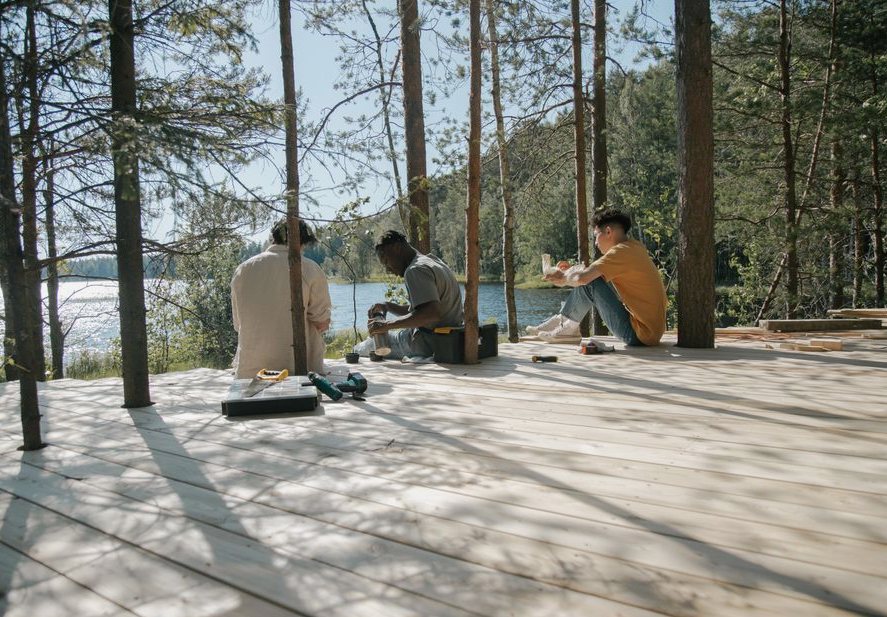
A Look at the Work
A few photos representative of the work.


How It Works
-
Call or Text
A two-minute call is enough to tell us what we're working with and what to check first.
-
On-Site Inspection
A tech inspects the problem in person — no guessing from photos, no drive-by quotes.
-
Clear, Written Quote
We put the fix, the timeline, and the number on paper — take your time with it.
Depending on what we find, that can mean:
- Install and flash the ledger board where the deck attaches to the house.
- Set joists at code-compliant spacing and spans, fastening them with appropriate hangers or connectors.
Typical Grants Pass Pricing
Ranges to budget around - every situation is priced on its own specifics.
$8100–$12100
Frequently Asked Questions
A 20x20 deck's price depends on material, height, railing, stairs, site access, and local permit requirements. The provided component ranges include labor $8,100-$12,100, decking $3,200-$4,800, framing $1,800-$3,000, railing $1,400-$2,600, stairs $700-$1,300, permits $50-$450, and fasteners $56-$1,100. A larger footprint mainly increases decking, framing, and labor hours rather than changing permit fees much.
The provided facts do not give one universal average, but they identify the main cost buckets: labor $8,100-$12,100, decking $3,200-$4,800, framing $1,800-$3,000, railing $1,400-$2,600, stairs $700-$1,300, permits $50-$450, and fasteners $56-$1,100. Your final price moves with deck size, material grade, height, access, soil, and inspection-required details.
Building it yourself may reduce the labor line item, which the provided facts place at $8,100-$12,100, but you still need decking, framing, railing, stairs, permits, and fasteners. DIY also requires layout, footing verification, ledger flashing, and code compliance. If you lack experience, mistakes in structure or flashing can cost more than professional installation.
Look for a contractor who confirms permits, setbacks, and inspection requirements before starting; lays out the deck area with strings, stakes, and batter boards; excavates and forms footings, then verifies depth and bearing before concrete; installs posts and beams for the load path; and flashes the ledger board. Get a written estimate, proof of insurance, references, and clear warranty and change-order terms.
It is a squaring check used during layout. The provided process says to lay out the deck area with strings, stakes, and batter boards before digging or framing; a 3-4-5 measurement is a common way to confirm those layout lines meet at a right angle before footings and framing begin.
Usually, yes: the provided process says confirm permits, setbacks, and inspection requirements with the local building authority before construction starts. Permit fees in the facts range $50-$450. Requirements vary by height, attachment to the house, footing depth, and zoning. Have the contractor verify before digging, because unpermitted work can affect inspections, insurance, and resale.
Tipping is not required. Deck builders are paid for a contracted scope, and the provided cost ranges cover labor, materials, railing, stairs, permits, and fasteners. If the crew exceeds expectations, such as a clean site, careful flashing, clear communication, and problem-solving, many homeowners give a modest holiday tip, meal, or positive review. Base any extra gesture on satisfaction, not obligation.
More Ways We Can Help
Serving Grants Pass and Nearby
Based in Grants Pass, OR. Call (458) 229-4197 to confirm coverage for your address.
Where We Stand Before You Call
- Free Estimates
- You pay for work, never for the quote.
- One crew from start to finish
- The people who start your job are the ones who finish it.
- You approve the scope before we start
- Nothing begins until you've signed off on the plan.
Free Quotes
Get a free quote today — call (458) 229-4197.
Updated October 2026